



What types of plastic exist?
Plastic is a material that is easy to find every day, whether in supermarkets or in our homes, no matter how hard we try to eliminate it from our lives.
Here you can learn about the different types of plastic and their negative environmental impact.
7 types of plastic
We often hear that plastic is the problem, but in reality, the problem is how we use it, because it is a good material if we use it over and over again.
It is made from polymers such as cellulose, coal, or crude oil and, although alternatives exist, plastic remains present on our planet, as can be seen from the chart below, which shows the global growth in plastic production.

PET: Polyethylene terephthalate
This type of plastic is one of the most widely used because it is lightweight, transparent, waterproof, impact-resistant, and easily recyclable.
It can be used in fabrics and food and cosmetic packaging.
HDPE: High-density polyethylene
Polyethylene is the most common plastic and is classified as high or low density. High-density polyethylene is a stiffer, chemical-resistant, and waterproof material. Unlike PET, which is made from petroleum, HDPE can be obtained from plant-based sources.
It is commonly used in containers, cleaning and personal hygiene product packaging, caps, and more.
PVC: Polyvinyl chloride
Due to its impact on the environment and human health, the use of PVC has decreased, as it can release harmful toxins (such as lead and dioxins, among others).
As a type of plastic that is rigid, waterproof, and durable, it has many applications. Thanks to these advantages and its low production cost, it is used in water and juice bottles, toys, pipes, medical equipment, and more.
LDPE – Low-density polyethylene
Unlike high-density polyethylene, low-density polyethylene is lightweight, flexible, transparent, and waterproof. Examples include shopping bags, household utensils, garbage bags, and food packaging films.
PP: Polypropylene
Polypropylene is one of the most durable plastics and is highly heat-resistant, making it ideal for food packaging. It is also rigid and can preserve aromas. It can be used to make containers, jars, and bottles.
PS: Polystyrene
Because it is flexible and has thermal insulation properties, it is frequently used in the food, packaging, and construction industries.
Like PVC, it is a hazardous material because it releases harmful toxins such as styrene.
Other types of plastic
There are also plastics that do not belong to any of the categories mentioned above or are combinations of several types. This category includes polycarbonates, which are used to make strong and durable products but contain chemical compounds (bisphenol A) that are harmful to the environment.
Which types of plastic are recyclable?
Now that you have an idea of the different types of plastic around us, it is worth knowing which ones we can recycle.
Several types can be easily recycled. However, according to a study published in the scientific journal Science Advances, only 9% of plastic has been recycled. Most is accumulated in landfills or ends up as litter in the oceans.
But which types of plastic can we actually recycle? There are thermosetting and thermoplastic plastics. While thermoplastics can be melted and transformed into new products, making them recyclable, thermosetting plastics cannot be melted and therefore cannot be recycled.
Plastics we can recycle
- PET: the most recycled plastic in the world, especially in fashion items;
- HDPE: one of the easiest polymers to recycle;
- PVC: although recyclable, the process is not considered industrially viable;
- LDPE: technically recyclable, but the process can be difficult;
- PP: difficult to recycle because it is mixed with other polymers;
- PS: difficult to recycle;
- Other: difficult to recycle.
According to the Smart Waste Portugal Association, “(…) most packaging in Portugal is recyclable.” In other words, there is recyclable packaging that can be recycled at some point in its life cycle, and there is packaging made from recycled materials.
What about packaging made from recycled materials, like EcoX packaging? What is the ideal percentage?
Mechanical recycling processes can result in performance losses, affecting appearance and functionality in terms of flexibility, stiffness, and strength.
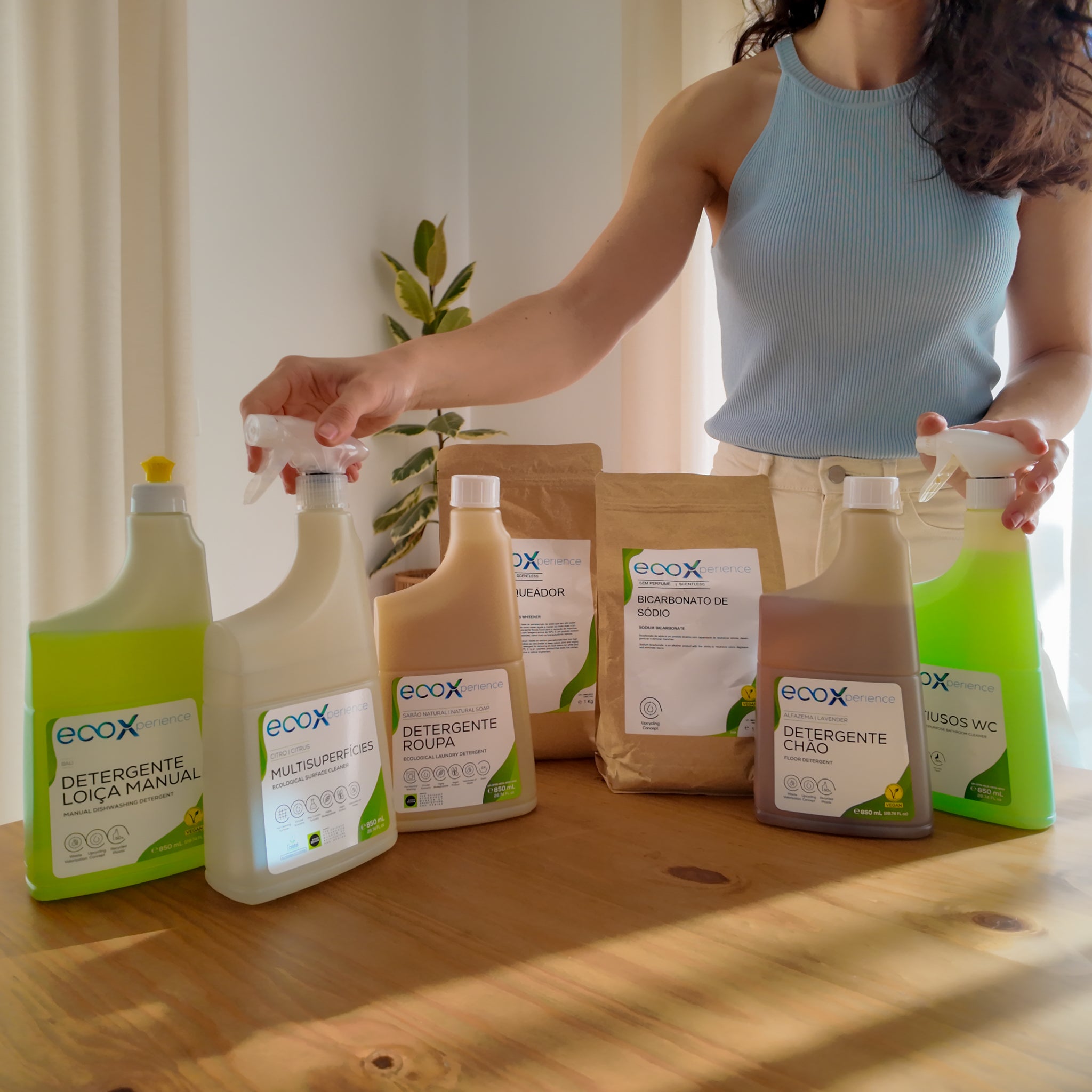
The new EcoX packaging is made of HDPE. In addition to being recyclable, this HDPE packaging can also be made from recycled material. It can be made with a higher percentage of recycled material; however, 50% is the amount that ensures chemical protection and maintains mechanical properties.
PET packaging, for example, can be molded using 100% recycled material; however, the color and functionality of the finished product may be affected.
Although it is important to create new packaging made from recycled material, the most important thing is to reuse packaging over and over again. That is why, to preserve the quality of the packaging and allow you to use it repeatedly with any EcoX detergent, the new packaging is designed for practical, circular use.
Follow our blog and stay up to date with more news and sustainability inspiration.
Author: Daniela Matos


